



Contest voting rules are the written terms that tell voters and entrants who may vote, how often, when voting starts and ends, what counts as a valid vote and who decides ties or disputes. Publish them before the first vote is cast, keep them identical everywhere you promote the contest, and choose a voting setup that can enforce each one. Izivote lets organizers choose open, paid, login-based or identity-based voting and set an automatic close, so the rules you write match what the platform actually does.
Key Takeaways
- Publish rules before voting opens: voting period, eligibility, vote limits, self-voting, paid votes, bots, ties and what happens if something breaks.
- The most common limit in public awards is one vote per person per category per day, and a clear definition of “person” (email, account, device) makes it enforceable.
- If voters can buy extra votes, say so openly, bar entrants from buying their own votes, and have the legal wording for your contest type checked.
- Rules only work when the tool enforces them: a fixed window, duplicate controls and a record of every vote.
- Announce results through a public channel and give entrants a clear way to raise a complaint.
Table of Contents
- Why written rules matter more than the voting tool
- The voting period
- Who can vote
- How many votes one person gets
- Self-voting, solicitation and vote farming
- Bots, automation and suspicious votes
- Paid votes: say it openly and mind the law
- Privacy and accessibility
- Ties, complaints and final authority
- Counting and announcing results
- Putting the rules into practice
- A starter rules checklist
- FAQ
- Sources
Why written rules matter more than the voting tool
A public vote is judged by the people who lose it. If entrants think the rules were vague or changed midway, they will question the winner no matter how many votes were cast. Written rules settle arguments before they start.
A useful guide to public-voting contests from a promotions administration firm lists what rules should cover: the voting period, voter eligibility, vote limits, self-voting, solicitation, automated votes, sponsor authority, ties and technical problems. Use that as a checklist, then fill in each item with the specifics below.
Two habits keep rules credible. First, say the same thing in every place: your entry page, your social posts and your official rules page. Second, reserve the right to correct problems, and say how you will tell people if a rule changes.
The voting period
State the exact start and end, with time zone. A fixed window is the simplest rule to defend. The Bravos rules, for example, give a fixed voting period with start and end times in Eastern Time. Newsweek’s Readers’ Choice terms use a 28-day voting period per category list.
Good practice:
- Open voting only after nominations close, so no one votes on an incomplete list. A university students’ union guide says the voting period should start only after the nominations period closes.
- Do not extend the window casually. Extending after seeing who is behind looks like tilting the result. If you need the right to extend (for an outage, say), write that into the rules in advance.
- Close automatically. Izivote supports automatic vote closing, so the deadline in your rules is the deadline on the page. Our help page on publishing and opening voting walks through going live.
Who can vote
Decide eligibility before you decide anything else, because it determines the voting method.
- Age. Many consumer awards require voters to be 18 or older, as in Newsweek’s terms and the Super Mom rules.
- Location. Some contests limit voters to a country. The Bravos rules require voters to be permanent legal residents of the United States or Washington, D.C. Others, like an Australian innovation award, limit eligibility to residents and exclude the organizer’s staff and their immediate family.
- Membership. For a school, club or company vote, voters should prove they belong. A University of Michigan guide says voting software should require some form of membership identification and limit voters to one vote.
A general principle from election practice applies at any scale: a voter list should ensure every voter can vote only once and keep ineligible people out. For a fan award that means choosing a voting mode that fits your audience. Izivote offers open, paid, login and identity-based modes; the voting types help page explains each. Student elections and member votes usually call for login or identity-based voting, and our student election page shows that setup.
How many votes one person gets
This is the rule people argue about most. Define three things: the unit (per contest, per category, per day), the identity (per email, account, device or IP address) and the consequence of breaking it.
| Common approach | Example from a public contest | Best for |
|---|---|---|
| One vote per person per category per day | Newsweek, The Bravos | Long campaigns with social sharing |
| One verified vote per category | An email-verified award vote | Short, trust-first awards |
| One free vote every 24 hours, extra votes by donation | Super Mom | Fundraising contests |
| One vote per position | Student organization elections | Schools, clubs, boards |
The daily vote has a logic worth explaining to entrants. One local newspaper’s contest FAQ says a vote per person per day per category rewards entrants with passionate supporters while still capturing name recognition. If you pick that model, say it plainly and note that you may adjust the limit with notice, as Bravo’s rules do.
Write “person” carefully. The same newspaper FAQ treats multiple email accounts as a rule violation. Say that creating extra accounts voids votes. Our guide on how to prevent duplicate votes covers the controls behind this rule.
Self-voting, solicitation and vote farming
Decide whether entrants may vote for themselves and whether they may ask for votes. Asking friends and followers is how most people’s-choice contests grow, so a ban on all solicitation is rare. What organizers do restrict:
- Entrants and their staff voting for themselves. Newsweek’s terms prohibit this.
- Offering prizes or other inducements in exchange for votes, which the same terms call out as prohibited.
- Paying for votes on one’s own behalf. The Super Mom rules prohibit competitors from paying or donating for their own votes, with possible disqualification.
Name the penalty: voided votes, a warning or disqualification. Rules without consequences are not rules. The University of South Carolina’s election guide makes the same point, directing organizers to publish rules, the consequences for breaking them and the full candidate list before voting.
Bots, automation and suspicious votes
Every public vote attracts scripts. Your rules should ban automated voting, macros and bots, and reserve the right to void votes you reasonably suspect are fraudulent, duplicated or automated. Both Newsweek’s terms and an Australian awards program’s terms include language like this, and a newspaper contest says organizers may eliminate suspect votes or remove entrants on evidence of fraud.
A reserved right is only useful if you can see what happened. Keep a record of when each vote came in and how it was verified. Our piece on the vote audit trail lists what to record, and the live vote monitoring view lets you spot a sudden spike while voting is still open rather than after it closes.
Paid votes: say it openly and mind the law
Paid voting turns a popularity contest into a fundraiser, and it works when everyone knows the terms. Your rules should state:
- That extra votes can be purchased, and the price per vote or bundle.
- Whether free votes still exist, and how often.
- Whether entrants may buy votes for themselves.
- Where the money goes (a charity, the event, prizes).
- The platform or processing fee, if it affects what a donor sees.
On Izivote, paid voting carries a platform fee of 10% per vote, and the paid voting page explains how payments are handled. For a comparison of the modes, read open voting versus paid voting.
One legal point matters in the US. A contest where entry depends on chance and requires payment can become an illegal lottery, and a promotions compliance guide notes that sweepstakes need a free alternate method of entry and that purchases cannot improve the odds. A vote-based award decided by counted votes is different from a random drawing, but the line depends on how prizes are awarded and on state law. If you offer prizes to voters, or you run a contest that pays out cash, have an attorney in your state review the rules. Our guide on online contest rules and lottery risk goes deeper.
Privacy and accessibility
If you collect emails or log-ins, say what you collect, why and who sees it. US privacy rules vary by state, so link a privacy notice from your voting page and ask counsel which state laws reach your contest. If you send text messages to voters, written consent is needed under FCC guidance, according to the same compliance guide.
For closed votes, privacy often means secret ballots. A published guide to anonymous elections describes a system where neither participants nor election chairs can see individual choices, yet each voter can vote only once. That is a good model for staff or member votes. Public fan awards usually show only totals.
Accessibility is a rule too. The Michigan guide recommends voting tools that are free to voters, accessible from all locations and offer a defined voting window. If your audience votes from phones, check your voting page on a small screen before launch.
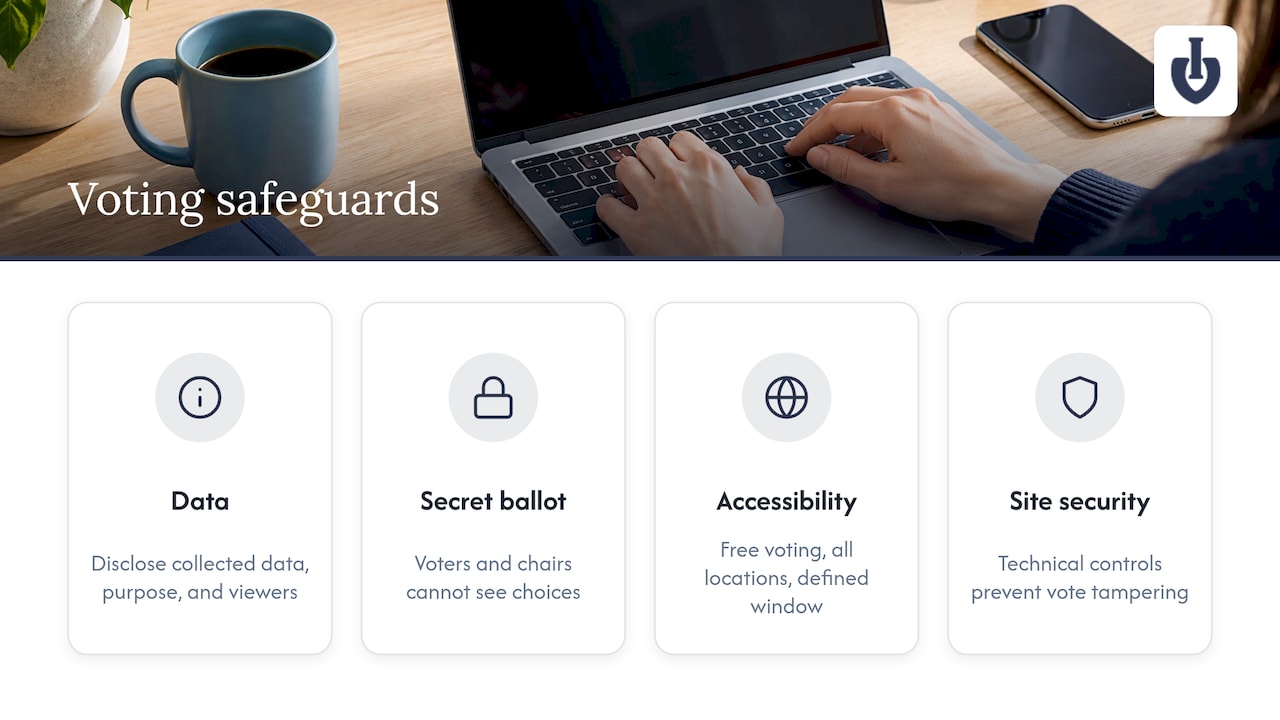
If you run your contest on your own website, protect the site as well. This guide to campaign website security fixes covers the technical controls that keep a public vote from being tampered with.
Ties, complaints and final authority
Decide in advance how a tie is broken: a runoff round, a judges’ panel, the organizer’s decision or co-winners. Student election guidance says that in a one-vote election the person facilitating the vote may act as tie-breaker. Whatever you choose, write it down.
Also write down:
- Final authority. State that the organizer’s decisions on eligibility and valid votes are final.
- Technical failures. Say what happens if the voting page goes down: extension, a restart or a void.
- Complaints. Give an email address and a deadline for raising a concern.
Close races happen. In one university presidential vote with thousands of voters, the first-round leader missed the winning threshold by two votes, and the authors found complaints easier to resolve when the system let people present evidence. A clear audit record does the same job for a fan award.
Counting and announcing results
Trust comes from showing your work. The Michigan guide advises that, if possible, more than one person should check the count, that results should be shared through accessible channels, and that organizers should confirm winners accept before announcing. The Cardiff students’ union guide adds that a member of staff must run the count.
For a public award, a live results page is the strongest form of transparency, and our guide on transparent voting results explains how to run one. For a live show, you can put totals on screen with a live event voting display.
Putting the rules into practice
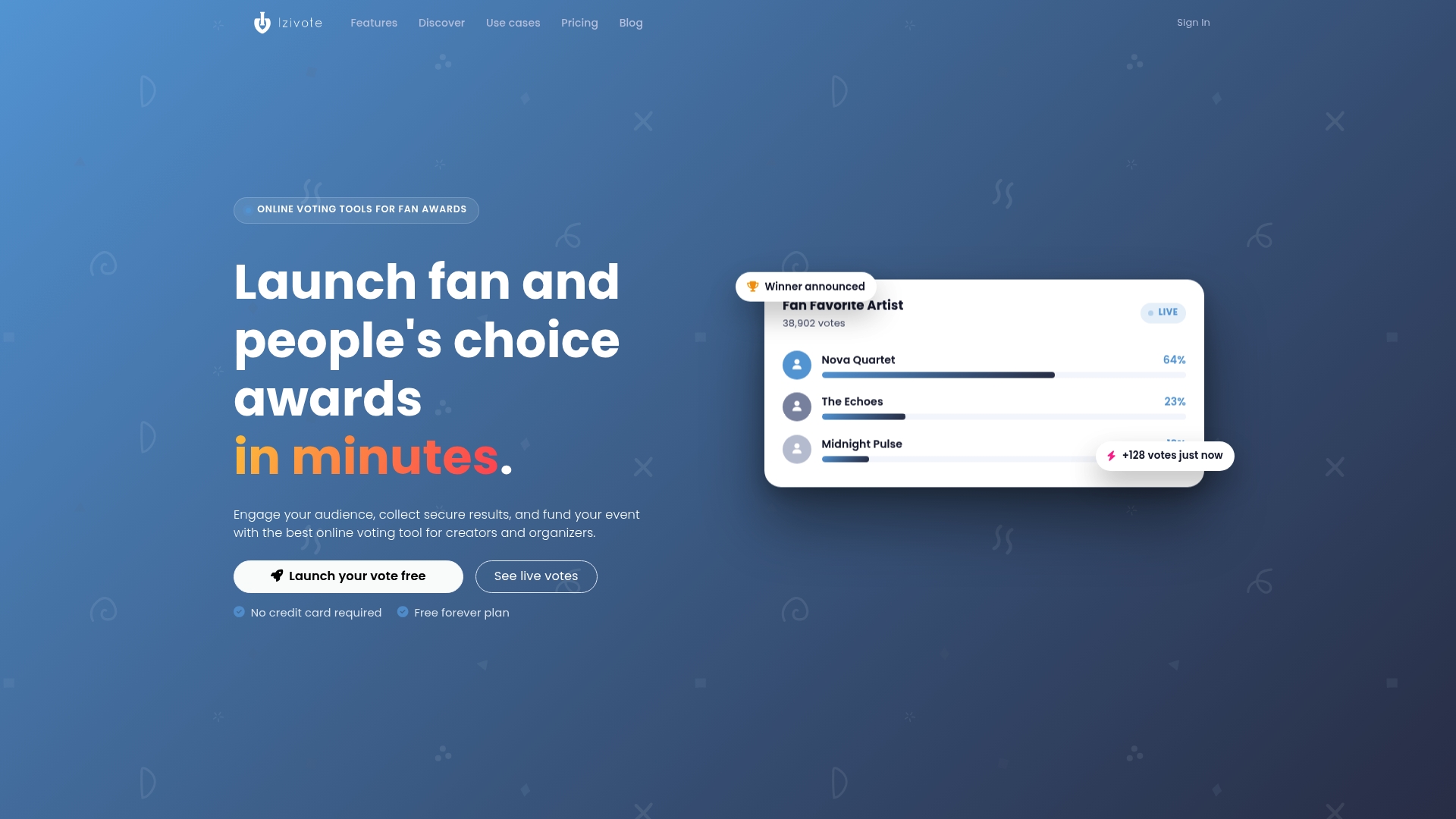
Izivote is built for audience and people’s choice awards. You can launch a vote on the free plan, then move to Pro at $6 per month ($60 per year) or Premium at $14 per month ($140 per year) as the event grows. Voting pages can be embedded on your own site, and nominees get photo profiles. A real-time dashboard shows votes as they arrive. Start from the people’s choice award page, compare plans on the pricing page, or create a vote.
The same rules work for community contests, school elections and corporate polls. Pick the voting mode that matches your eligibility rule, then copy the structure below.
A starter rules checklist
- Name of the contest and organizer.
- Start and end date and time, with time zone.
- Who may vote (age, location, membership) and who may not.
- Vote limit and how “person” is identified.
- Whether entrants may vote for themselves or solicit votes.
- Whether votes can be purchased, at what price, and where proceeds go.
- Ban on bots, scripts and multiple accounts, with the penalty.
- Right to void suspicious votes.
- Tie-break method.
- How results will be announced.
- How to contact the organizer with a complaint.
- What happens in a technical failure.
- Privacy notice and consent wording.
FAQ
How long should a contest voting period be?
There is no standard. Public examples range from about a week, as in a TV awards vote, to 28 days per category list. Pick a window long enough for entrants to rally supporters and short enough to keep momentum.
Can entrants vote for themselves?
It is your call, but many contests bar it. Some prohibit entrants and their staff from voting for themselves. If you allow it, say so, so no one is surprised.
Is paid voting legal for a contest?
Often yes for vote-based awards and fundraisers, but it depends on how winners are chosen and where you operate. Contests that rely on chance and require payment can be treated as lotteries, so have an attorney in your state review the rules before you sell votes.
What if two entrants tie?
Write the tie-break into your rules before voting opens: a runoff, a judges’ decision, the organizer’s decision or co-winners. Student election guidance lets the person running the vote break a tie.
Sources
- Public Voting Contests: Rules, Risks and Best Practices
- Newsweek Readers’ Choice Terms and Conditions
- Finder People’s Choice Innovation Awards Terms
- Super Mom rules
- The Bravos Voting Rules and Procedures
- Elkins People’s Choice FAQ
- University of Michigan remote elections guide
- University of South Carolina student organization election guide
- Cardiff Students’ Union online election guide
- OSCE/ODIHR handbook on voter registration
- Guidelines for anonymous TAC elections
- E2E voting systems paper, university president election
- 2026 Sweepstakes and Promotions Compliance Guide
- Campaign Website Security: 7 Essential Fixes
Recommended