



To set up people’s choice voting, you need six decisions made in order: what you are awarding, who may vote and how, what a vote costs (if anything), how you will stop cheating, when voting opens and closes, and how you will announce the result. Do those well and the software part takes an afternoon. This guide walks through each decision, with the settings we see organizers get wrong most often.
Key takeaways
- Decide the voting rules before you touch any tool: categories, one vote or many, free or paid, and whether voters must identify themselves.
- Match the voting mode to the risk. A office-snack poll can be open; a cash-prize award needs login, identity checks or paid votes.
- Publish your anti-fraud rules on the voting page itself, and watch results live while voting runs.
- Treat a public vote as a popularity contest, not a measure of quality, and say so.
- A free plan covers small events. Paid voting carries a 10% platform fee per vote on Izivote, so price your votes with that in mind.
Table of Contents
- Start with what the vote is for
- Design the ballot: categories and nominees
- Choose a voting mode
- Set up the vote in Izivote, step by step
- Block fraud before it starts
- Decide on a timeline
- Promote the vote
- Be honest about what the result means
- What it costs
- Start your people’s choice vote
- Announce the result
- FAQ
- Sources
Start with what the vote is for
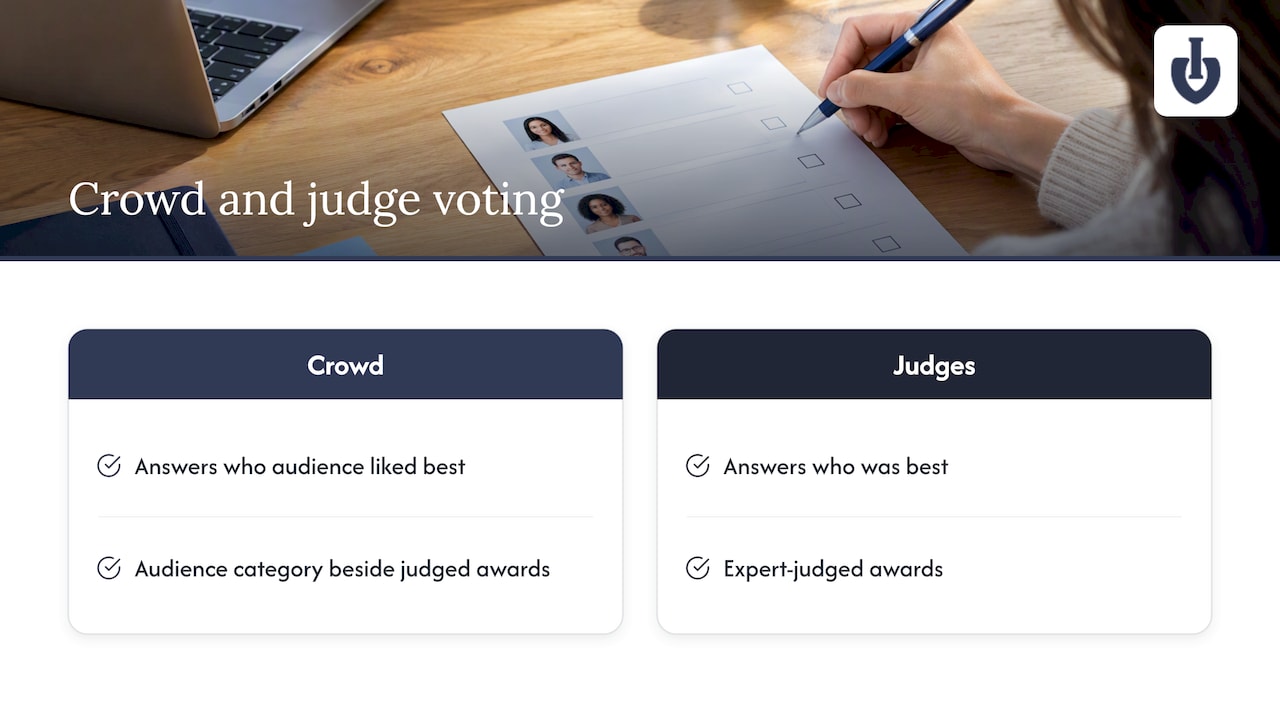
A people’s choice award answers one question: who did our audience like best? That is a different question from “who was best?” Judges answer the second. The crowd answers the first.
This matters for setup because it shapes every later choice. Public voting tends to work best as an audience category that sits alongside expert-judged awards, so the crowd gets a say without putting your main categories at risk, as Zealous notes in its practical guide to public voting. The same article lists the usual failure modes: bot fraud, repeat voting through VPNs and coordinated group voting.
The BBC takes a similar view. Its editorial guidance on voting says the robustness of the voting mechanism should match the editorial significance of the vote. In plain terms: the more your result matters, the tighter your rules should be.
Write one sentence before you go further, for example: “Fans choose their favorite food truck at the Riverside Festival, and the winner gets a feature on our website.” If you cannot write that sentence, you are not ready to build the ballot.
Design the ballot: categories and nominees
Keep categories few and clear
Every category is a separate decision for the voter and a separate thing for you to promote. Five to ten categories is a comfortable range for most community awards. Past that, voters skip categories and your promotion gets diluted.
Name categories so a stranger understands them without a rulebook: “Best Local Coffee Shop” beats “Excellence in Hospitality (Beverage).” If a nominee could fit two categories, decide now whether it may appear in both.
Decide how nominees get on the ballot
You have three common routes:
- You pick them. Fastest, and the best for small, curated events such as a talent show or a pageant.
- The public nominates. Good for community awards where you do not know every candidate. Collect nominations first, then screen them, then open voting.
- Self-nomination. Entrants put themselves forward. This works well for contests and creator awards, but you should review entries before they go live.
Whichever route you choose, collect the same things for each nominee: name, a clear photo, a one- or two-line description, and a link if relevant. Voters respond to faces and short stories. A ballot of bare names favors whoever is already famous.
Set the voting rules for nominees too
Tell nominees in writing what they may and may not do. Can they ask friends to vote? Can they offer prizes for votes? Can they run ads? Decide now, because you will be asked in week one.
Choose a voting mode
This is the decision with the biggest effect on integrity. The main options are:
| Mode | How it works | Best for | Main risk |
|---|---|---|---|
| Open | Anyone with the link can vote | Low-stakes polls, classroom or office fun | Easy to repeat-vote |
| Login | Voters sign in before voting | Community awards, fan clubs | Fake accounts |
| Identity-based | Votes are tied to a verified identity | Higher-stakes awards | More friction for voters |
| Paid | Each vote is bought | Fundraisers, fan awards | Perceived pay-to-win |
Izivote supports all four modes, and its help page on voting types and voter identity explains how each one behaves. You can mix approaches across events, but keep one mode per category so the rules stay easy to explain.
When paid voting makes sense
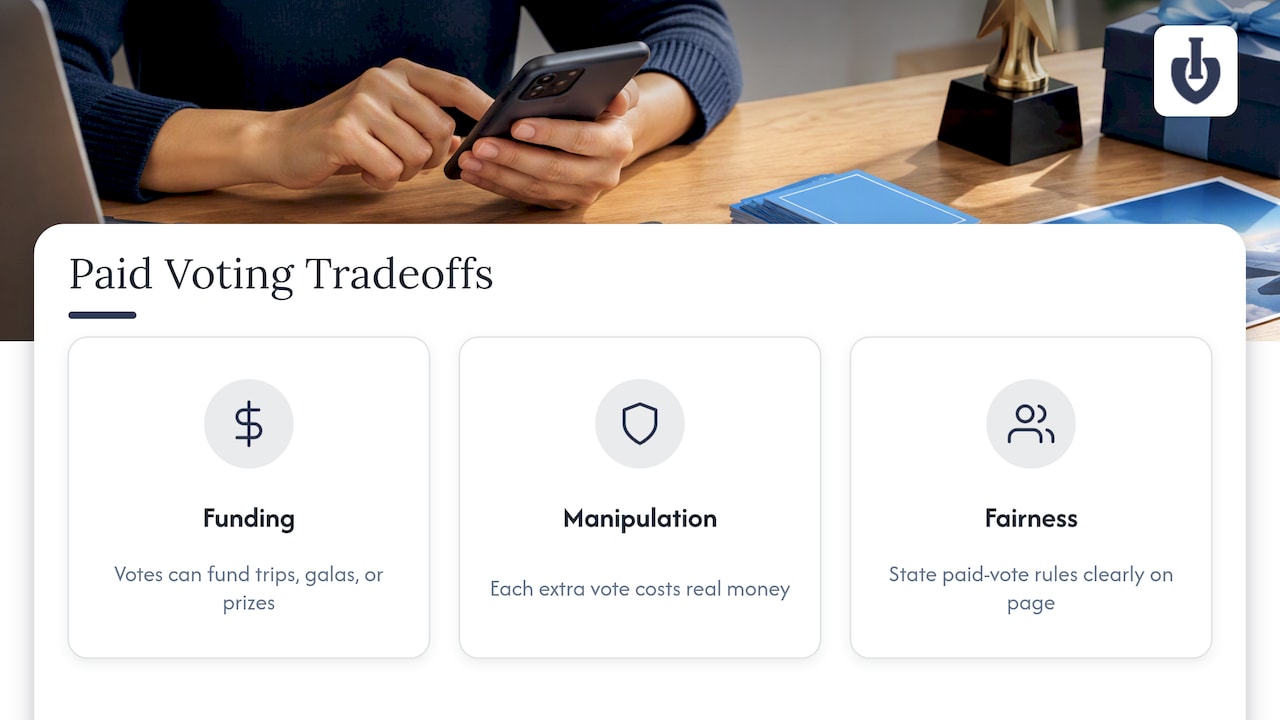
Paid votes turn enthusiasm into funds. A school can raise money for a trip, a nonprofit can fund a gala, a fan community can cover prizes. They also make casual manipulation expensive, because every extra vote costs real money.
The tradeoff is perception. If the highest spender always wins, the award loses meaning for people who cannot pay. Many organizers handle this by running a free vote and a paid vote side by side, or by making paid votes a bonus on top of one free vote per voter. If you go this route, state it clearly on the voting page. We go deeper on the money side in our piece on monetizing fan voting, sponsors and fairness.
Set up the vote in Izivote, step by step
Here is the practical sequence on our platform. It takes most organizers well under an hour for a first event.
- Create the vote. Start from the create-a-vote page. Give it a plain title and a short description of who can vote and why.
- Add categories. One per award. Order them the way you want voters to see them.
- Add nominees. Upload a photo and a short profile for each. If you allow self-nomination, turn it on here.
- Pick the voting mode. Open, paid, login or identity-based, as above.
- Set the schedule. Choose the opening time and the automatic closing time so voting ends exactly when you said it would.
- Preview as a voter. Open the page on your phone, not just your laptop. Most votes come from phones.
- Publish and share the link, or embed the voting page on your own website so people never leave your brand.
Once voting is live, the organizer dashboard shows votes in real time, so you can see which categories are moving and spot odd spikes. For more on this kind of event, see our page on people’s choice voting tools.
Block fraud before it starts
Fraud prevention is mostly design, not detective work. Four habits help.
Say the rules out loud
Award Force advises declaring a zero-tolerance policy and publishing it in bold on the voting page, with the penalties spelled out: fraudulent votes removed, or entrants disqualified. A visible rule deters casual cheating and gives you cover if you need to enforce it.
A short version works. For example: “Votes obtained through bots, vote-buying outside the official process or multiple accounts will be removed. Entrants who benefit may be disqualified.”
Match friction to stakes
A vote for the best pumpkin at a church fair does not need identity checks. A vote that decides a sponsored prize does. Add friction only where the stakes justify it, because every extra step costs you voters.
Watch the live numbers
The same Award Force guide suggests tracking the vote in real time to catch unusual patterns, and auditing votes afterward if something looks wrong. Check the dashboard at least daily. Red flags include a nominee gaining thousands of votes overnight while others are flat, or a cluster of votes arriving within seconds.
Keep the right to remove votes
Put in your terms that you may void suspicious votes and that your decision is final. Then, if you act, act the same way for everyone.
Decide on a timeline
Voting windows are a balance. Too short and you miss people. Too long and attention fades.
- Small community or school vote: one to two weeks.
- Public award with promotion: two to four weeks, with a clear countdown.
- Live event vote: a window that opens at the start of the show and closes at a set moment on stage.
For reference, one large, established fan award runs a 21-day official window, according to its published voting FAQ, though we recommend sizing yours to your audience, not copying a national event. Whatever you pick, announce the close time with a time zone, and let automatic closing do the work so nobody has to be awake at midnight.
For live events specifically, our guide to live event voting and audience polls covers how to run the vote on screens in the room.
Promote the vote
A vote nobody hears about produces a result nobody trusts. Plan promotion as part of setup:
- Give nominees a shareable link and a ready-made message. They will do most of your marketing.
- Embed the ballot on your site and send newsletters with the direct link.
- Post progress updates, but think about what you show. Live public results build transparency and excitement, though they can also encourage ballot-stuffing toward the end. If your event is sensitive, consider showing standings only for the final day or hiding exact counts until the close.
- Use reminders. A message two days before closing typically brings a second wave of votes.
If you run sports or team awards, keep in mind that fans and experts often disagree about who was best. This explainer on why match awards and live stats diverge is a useful reminder of why a fan vote deserves its own category, separate from any judged award.
Be honest about what the result means
An online public vote is a self-selecting sample. People who vote are the ones who care, or the ones whose friends asked them to. The BBC’s guidance says producers should treat such votes this way and report the limitation, rather than presenting the result as representative of the public.
You do not need to hedge every announcement. A simple line is enough: “The winner was chosen by votes cast by our community between these dates.” That is accurate, and it protects your credibility.
What it costs
Izivote’s pricing is published on the pricing page. As of today, the plans are:
| Plan | Monthly | Yearly |
|---|---|---|
| Free | No published price | No published price |
| Pro | $6 per month | $60 per year |
| Premium | $14 per month | $140 per year |
Paid voting adds a 10% platform fee per vote. Do the math before you set a vote price. If you charge $1 per vote, the platform fee is $0.10 on each, so you keep the rest of the amount before any other processing costs. Decide whether that is acceptable, or whether your vote price should be higher. A small event can start on the free plan and move up only if it needs more.
Start your people’s choice vote
If you want a ballot with nominee photos, several voting modes, live results and automatic closing, you can create your vote on Izivote without paying anything up front. Fan awards, pageants, school contests and community polls are all common uses; the fan awards page shows how they look in practice, and the awards and competitions page covers programs that mix public and judged elements.
Announce the result
Close on time, check the final counts, and review any flagged votes before announcing. Then publish:
- the winner and the final standings, if you showed them during voting;
- the voting period and the method;
- a thank-you to every nominee, not just the winner.
Keep the results page live. Winners will share it, and it becomes the best advertisement for next year’s edition.
FAQ
How long does it take to set up a people’s choice vote?
For a small event with a handful of categories, you can have a working ballot in under an hour if you already have nominee names and photos. The slow part is almost always gathering those photos and writing short profiles. Start there.
Should voters be allowed to vote more than once?
It depends on your goal. One vote per person is the cleanest for fairness. Multiple votes, especially paid ones, suit fundraisers. Whichever you choose, state the rule on the voting page and set the voting mode to enforce it.
Is paid voting fair?
It can be, if you are open about it. Many organizers pair a free vote with optional paid votes so that everyone has a voice, and then explain where the money goes. Hiding the rule is what damages trust, not the payment itself.
Can I run a people’s choice vote alongside judges?
Yes, and that is a common format. Keep the two results separate, with different award names, so nobody confuses a popularity result with a judged one.
Sources
- BBC Editorial Guidelines: Audience Interactivity, Part C (voting)
- Award Force: How to avoid fraudulent voting in public awards programs
- Zealous: When does public voting work in awards?
- People’s Choice Awards
Recommended