

Every online contest needs a published set of official rules covering eligibility, entry instructions, prize details, winner selection, start and end dates, how winners claim prizes, and privacy disclosures. Whether you’re running a sweepstakes, a skill contest, or a public vote, you also need to confirm which state, national, or platform rules apply before launch, since a missing “no purchase necessary” clause or buried disclosure can turn a fun promotion into a legal problem.
TL;DR:
- Classify the promotion first: chance based sweepstakes need a free entry route, skill contests need stated judging criteria, and fan votes need transparent mechanics.
- In the UK, a free route must match the paid option’s convenience and cost, receive equal prominence, and carry no preference in prize allocation.
- Link full rules from every entry point, covering eligibility, prizes, determinable odds, dates and time zone, winner selection, claim deadlines, privacy, and optional marketing consent.
- For vote based contests, retain timestamped vote logs, disclose any per vote price, and use identity checks to limit duplicate ballots without excess data collection.
- Before opening entry across more than two or three countries, check local laws and data rules, review platform policies, and seek jurisdiction specific legal advice.
Table of Contents
- What’s the difference between a giveaway, contest, and sweepstakes?
- The legal checks that protect your contest from day one
- Every clause your official rules document needs
- How to turn this checklist into published rules
- What social platforms expect from your contest
- Running a contest across more than one country
- Running a secure, auditable vote-based contest
- Copy-ready rule snippets you can adapt
- Why short, visible rules matter more than organizers think
- How Izivote supports transparent vote-based contests
- FAQ
- Sources
What’s the difference between a giveaway, contest, and sweepstakes?
The words get used interchangeably online, but each term carries a distinct legal meaning that determines which rules apply to your promotion.
A sweepstakes is chance based: winners are drawn at random, and in the United States, charging an entry fee or requiring a purchase to enter turns a legal sweepstakes into an illegal lottery unless a free entry route exists. A contest or prize competition is skill based: entrants submit something (a photo, an essay, a video) that gets judged against stated criteria, which generally allows an entry fee because the outcome depends on merit rather than luck. A fan vote sits in its own category: the audience picks a winner from a pool of nominees, and the mechanics (open voting, paid voting, login-based voting) shape whether extra legal review is needed.
- Sweepstakes: winner chosen by chance, no purchase can be required.
- Contest: winner chosen by skill or judging criteria, entry fees are typically allowed.
- Prize competition (UK terminology): entry usually requires a modest skill element to stay outside gambling law.
- Fan vote: winner chosen by audience ballots, which may include free, paid, or identity-verified voting.
Getting this classification wrong is the single most common mistake organizers make. A “vote for your favorite photo” contest that charges per vote and picks the winner purely by vote count can look a lot like a paid lottery unless it is structured and disclosed correctly.
The legal checks that protect your contest from day one
Before you write a single line of official rules, run your promotion through what regulators call the lottery test: a promotion becomes an illegal lottery when it combines chance, a prize, and consideration (something of value paid or given to enter). Remove any one of those three elements and you’re generally in the clear. Skill contests remove chance. Free-entry promotions remove consideration. Non-prize engagement campaigns remove the prize.
For promotions that keep an element of chance, the fix is a free entry route. In the United States, the FTC’s guidance on sweepstakes and lottery scams makes clear that a legitimate sweepstakes must be free to enter and cannot ask entrants to pay taxes, shipping, or processing fees to claim a prize, since those requests are classic scam indicators. In the United Kingdom, the standard is more specific: the Gambling Commission’s guidance on free draws and prize competitions requires that a free route be no more expensive and no less convenient than the paid route, promoted with equal prominence, and treated without any preference in prize allocation.
Statistic callout: The FTC’s 2023 enforcement action against Publishers Clearing House documents how buried “no purchase necessary” text and interface sequences that implied a purchase improved odds led to a formal complaint, a reminder that disclosure placement is itself a compliance issue, not just a wording one.
A few more checks worth running early:
- Confirm whether your state or country requires registration or bonding for sweepstakes above a certain prize value; some U.S. states, like New York, maintain dedicated registration pages for games of chance.
- Decide if your promotion needs geographic restrictions, since laws differ sharply between jurisdictions.
- Check that your “no purchase necessary” or free-route language appears on the entry screen itself, not just in a linked rules document.
- Review your platform’s own promotion policies (Instagram, Facebook, TikTok) before you build your entry flow.
A voluntary UK industry code for prize draw operators sets out transparency principles for this exact situation, but it’s worth noting that it is guidance, not legislation. It does not replace a jurisdiction-specific legal review, and organizers running cross-border promotions should treat it as a baseline rather than a safe harbor.
Every clause your official rules document needs
Your official rules page is the single source of truth for the promotion. Courts, regulators, and platforms all point back to it when a dispute arises, so it needs to be complete, specific, and easy to find.
- Promoter identity and contact information, including the legal entity name running the promotion.
- Eligibility and exclusions, covering minimum age, country or state of residence, and whether employees, sponsors, or their household members can enter.
- Entry instructions, written step by step, including any technical requirements like account creation or app downloads.
- Prize description and retail value, plus a substitution clause if the stated prize becomes unavailable.
- Odds of winning, stated when they’re mathematically determinable, along with any maximum number of entries per person.
- Start and end dates and times, specified with time zone, and naming the official timekeeping device for disputes.
- Winner selection method, described clearly enough that an outside party could verify it was followed.
- Notification and claim process, including the deadline a winner has to respond before forfeiting the prize.
- Disqualification and reserve-winner procedures, covering fraud, ineligibility, or non-response.
- Privacy and marketing disclosures, with marketing opt-in kept as a separate, optional checkbox from entry itself.
- Data retention and sharing terms, stating how long entry data is kept and whether it’s shared with third parties.
- Governing law, “void where prohibited,” and a limitation of liability clause protecting the promoter from claims tied to prize use.
Pro Tip: Write your odds-of-winning clause as a formula (“1 in total number of eligible entries received”) rather than a fixed number, since entry counts change until the promotion closes.
How to turn this checklist into published rules
Drafting official rules works best as a sequence rather than a single document you write once and forget.
- Decide the promotion type and geographic scope before writing anything else, since that choice determines whether you need a free-entry route.
- Draft eligibility language and exclusions in plain terms, naming minimum age and any excluded groups explicitly.
- Write the entry flow, then walk through it yourself on both desktop and mobile to confirm every step works as described.
- Document prize fulfillment, including shipping timelines, tax reporting obligations, and who covers delivery costs.
- Specify your winner selection method and backup winner process, and decide what audit trail you’ll keep proving the draw was fair.
- Separate marketing consent from entry consent, and test that unchecking the marketing box doesn’t block entry.
- Publish the rules where every entry point links to them, including social posts, landing pages, and mobile entry forms.
Pro Tip: Test your entire entry flow from a phone on mobile data, not just a laptop on office Wi-Fi, since slow load times or hidden links are what actually cause entrants to miss your free-route option.
What social platforms expect from your contest
Running a contest through Instagram, Facebook, or TikTok adds a second layer of rules on top of your legal obligations. Most platforms require promotions to carry a line stating the promotion is in no way sponsored, administered, or associated with the platform itself, and all entry mechanics have to comply with the platform’s own promotion guidelines.
- Avoid entry flows that make tagging, sharing, or purchasing look mandatory when they’re actually optional alternatives to a free route.
- Link your full official rules from every post or story that promotes the contest, not just the original announcement.
- Keep the platform disclaimer and the official rules link visible without requiring entrants to click “see more.”
- Recheck platform terms periodically, since social networks update promotion policies more often than most organizers expect.
Running a contest across more than one country
Cross-border promotions multiply the number of rules you need to track. Add “void where prohibited” language and restrict entry by country or state wherever a jurisdiction’s laws conflict with your mechanics.
- Confirm whether your free-route obligations differ by country. The UK’s free-route standard is stricter than typical U.S. practice.
- Separate data consent requirements by region, since cross-border data transfer rules affect how you collect and store entrant information.
- Exclude jurisdictions outright when local law makes compliance impractical, rather than trying to adapt one rules document to every market.
- Get jurisdiction-specific legal counsel before launching a promotion open to more than two or three countries.
Running a secure, auditable vote-based contest
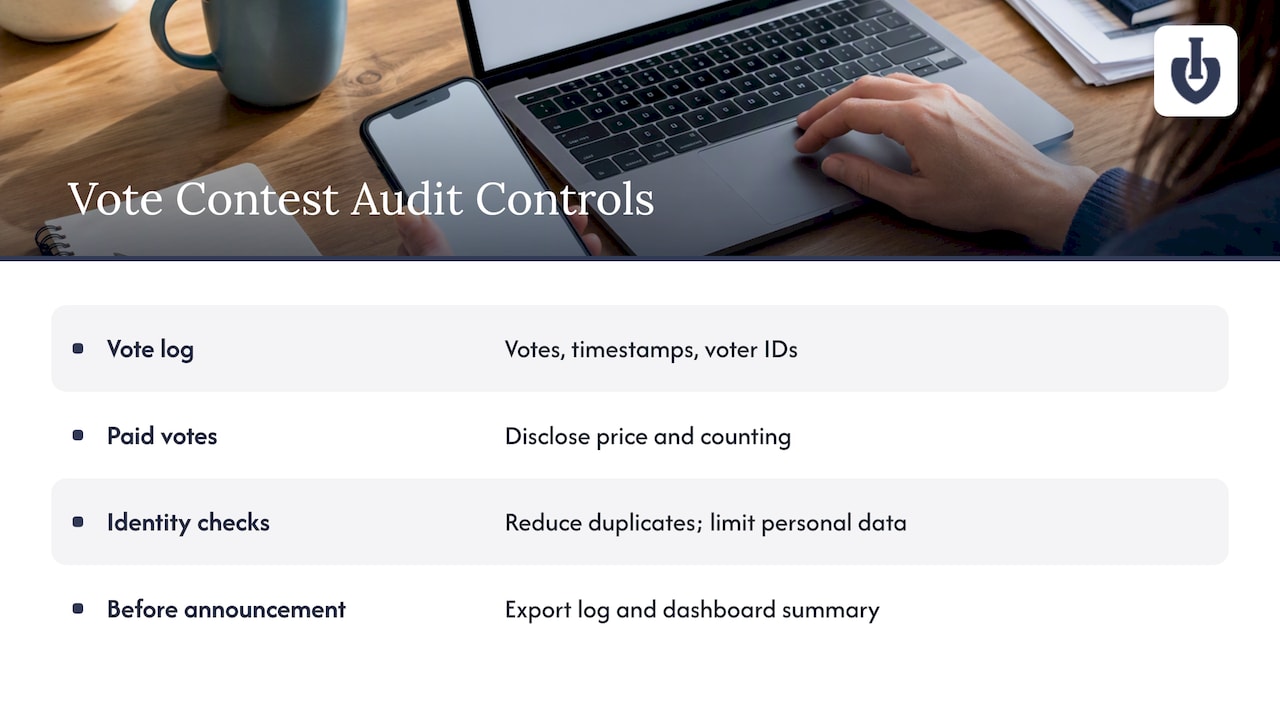
Vote-based contests carry their own transparency burden. Keeping a server-side log of votes, timestamps, and voter identifiers lets organizers reconstruct results if a winner is challenged. Paid votes need their own disclosure, a clear per-vote price, and confirmation that paid and free votes (where both exist) are counted without hidden preference. Identity checks, like requiring a login or verified account, cut down on duplicate voting without exposing unnecessary personal data.
Pro Tip: Export your vote log and dashboard summary before announcing a winner, so you have a timestamped record ready if anyone disputes the result.
Copy-ready rule snippets you can adapt
A few short clauses cover most of what a basic promotion needs, though every one should be adjusted to your actual jurisdiction and prize before publishing.
- Eligibility: “Open to legal residents of [region] who are 18 years of age or older at the time of entry. Employees of [company] and their immediate family members are not eligible.”
- No purchase necessary: “No purchase is necessary to enter or win. A purchase will not increase your chances of winning.”
- Prize description: “One winner will receive [prize], with an approximate retail value of [amount]. No cash substitution except at the sole discretion of the promoter.”
- Winner notification: “The winner will be notified by email within [X] days of the drawing and must respond within [X] days to claim the prize or risk forfeiture.”
Host the full rules on a dedicated page linked from every entry point, not buried in a footer. For vote-based promotions, add a line disclosing any paid-vote option and confirming that it does not grant special placement in the results. Organizers looking for ready-made clause structures for creative-entry contests can also check photo contest rule templates, which cover common clauses for submission-based competitions.
Why short, visible rules matter more than organizers think
Clear rules that entrants can actually find prevent most disputes before they start. The organizers who get burned usually didn’t skip the legal language, they just buried it. A visible free-route link or one extra click to the full rules feels like friction in the moment, but it’s the difference between a smooth prize claim and a public complaint thread.
— Joshua
How Izivote supports transparent vote-based contests
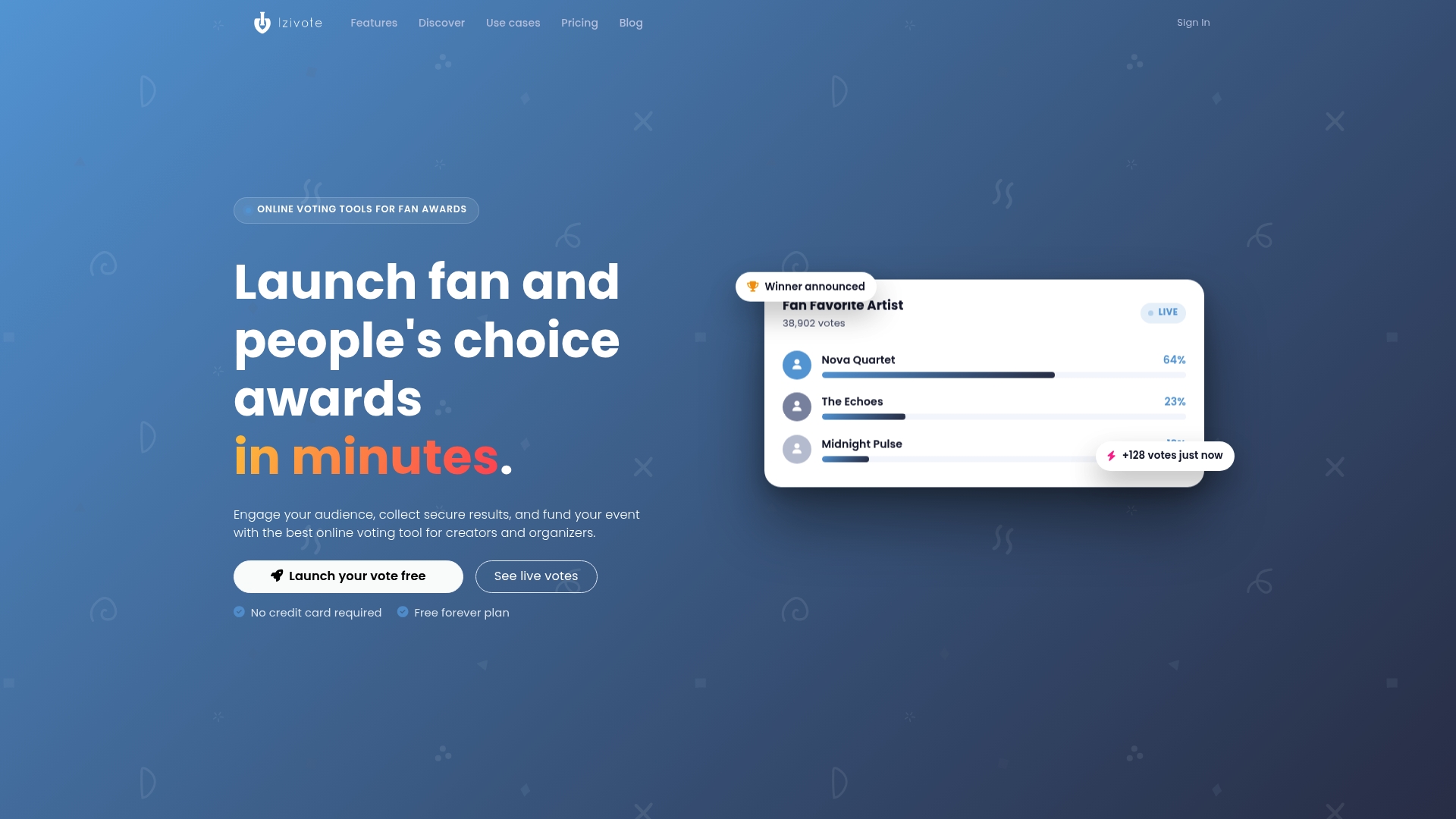
Running a fan vote or people’s choice award means your winner selection needs to hold up to scrutiny, and that’s the part we built around. The platform logs every vote in real time, handles paid-vote collection with transparent per-vote pricing, and offers identity-based voting when needed to confirm each voter is who they claim to be. Organizers running awards and competitions or fan choice awards get a live dashboard to back up their results the moment a winner is announced.
If paid voting is part of your contest, our paid voting setup keeps pricing and vote counts visible to organizers throughout the campaign. Start with our Free plan to test the mechanics, or check Pro or Premium plans with monthly or yearly billing on the pricing page when you’re ready to launch.
FAQ
What are the legal rules for giveaways in the US?
A legitimate U.S. giveaway must be free to enter or offer an equally convenient free-entry route, since charging for entry or improving odds through payment can turn a sweepstakes into an illegal lottery under the FTC’s guidance. Organizers also need to publish eligibility, prize value, and odds (when determinable) clearly and conspicuously, not buried in fine print.
How do I set up a contest?
Start by classifying the promotion as a sweepstakes, skill contest, or vote, since that determines whether a free entry route is legally required. From there, draft your official rules covering eligibility, entry steps, prizes, winner selection, and dates, then test the entire entry flow on both desktop and mobile before publishing it.
Can you give an example of a contest?
A skill-based photo contest where entrants submit images judged on criteria like composition and creativity is a classic example, since the outcome depends on judging rather than chance. A fan vote where an audience selects their favorite nominee from a published list is a different example, often run through dedicated voting software to keep results auditable.
What should organizers avoid when running giveaways?
Organizers should avoid requiring any payment or purchase to enter a chance-based giveaway without offering an equally visible free route, since that structure can resemble an illegal lottery. They should also avoid burying “no purchase necessary” language, as FTC enforcement history shows that disclosures must be conspicuous, not just technically present.
Sources
- Fake prize, sweepstakes, and lottery scams | FTC
- Free draws and prize competitions – Gambling Commission
- Gov
- FTC takes action against Publishers Clearing House misleading consumers about sweepstakes entries
Recommended