



Live results at an award show come from three things working together: a fixed voting window, a counting system that updates as votes arrive, and a verification step before anyone announces a winner. Big broadcasts keep a live leaderboard moving, then validate the final tally before the reveal. You can run the same model for a fan award, a pageant or a community event with an online voting platform, a results screen and a clear rulebook.
This guide explains how the big shows do it, what you can borrow at any size, and how to set up your own live results without losing the audience’s trust.
Key Takeaways
- Live results are a display choice. You can show a running leaderboard, show nothing until the reveal, or share a temporary ranking and confirm the final tally after voting closes.
- Set the voting window, the rules and the voter identity method in writing before voting opens.
- Protect the count with identity checks, vote limits and monitoring. Then verify before you announce.
- Leave time between the close of voting and the reveal. Live programming needs that gap for the final tally.
- A platform with real-time dashboards, embeddable voting pages and automatic vote closing removes most of the manual work.
Table of Contents
- What “live results” means at an award show
- How the big broadcasts handle live voting
- Choose your results format and rules before voting opens
- Choose a voting method that matches your audience
- Show live results without losing trust
- Keep the count clean: duplicates, fraud and monitoring
- Verify the tally and announce winners
- A run-of-show timeline for a live award
- Privacy, accessibility and payments to plan for
- Run live results with Izivote
- Pre-launch checklist
- FAQ
- Sources
What “live results” means at an award show
People search for “award show live results” for two different reasons. Some want the winners as they are announced on television. Others, and this guide is for them, run an award and want to show results while the audience votes.
For organizers, live results usually means one of three formats:
- Running leaderboard. Vote totals update on a public page or a screen as votes come in.
- Hidden count, live reveal. Votes are collected and counted in the background. Nobody sees totals until the announcement.
- Hybrid. A temporary ranking or a top-three view is shown during voting, and the confirmed result follows once voting closes and the tally is checked.
Each format changes how people behave. A running leaderboard drives excitement and sharing, because nominees and their fans can watch progress and push for more votes. A hidden count protects the surprise and cuts down on last-minute vote swings. The hybrid keeps energy high without promising a final result before it is verified.
Choose the format first. Everything else, from the technology to the script on stage, follows from it.
How the big broadcasts handle live voting
Television shows are a useful model because they deal with huge volumes, hard deadlines and public scrutiny.
Eurovision: instant recording, careful validation
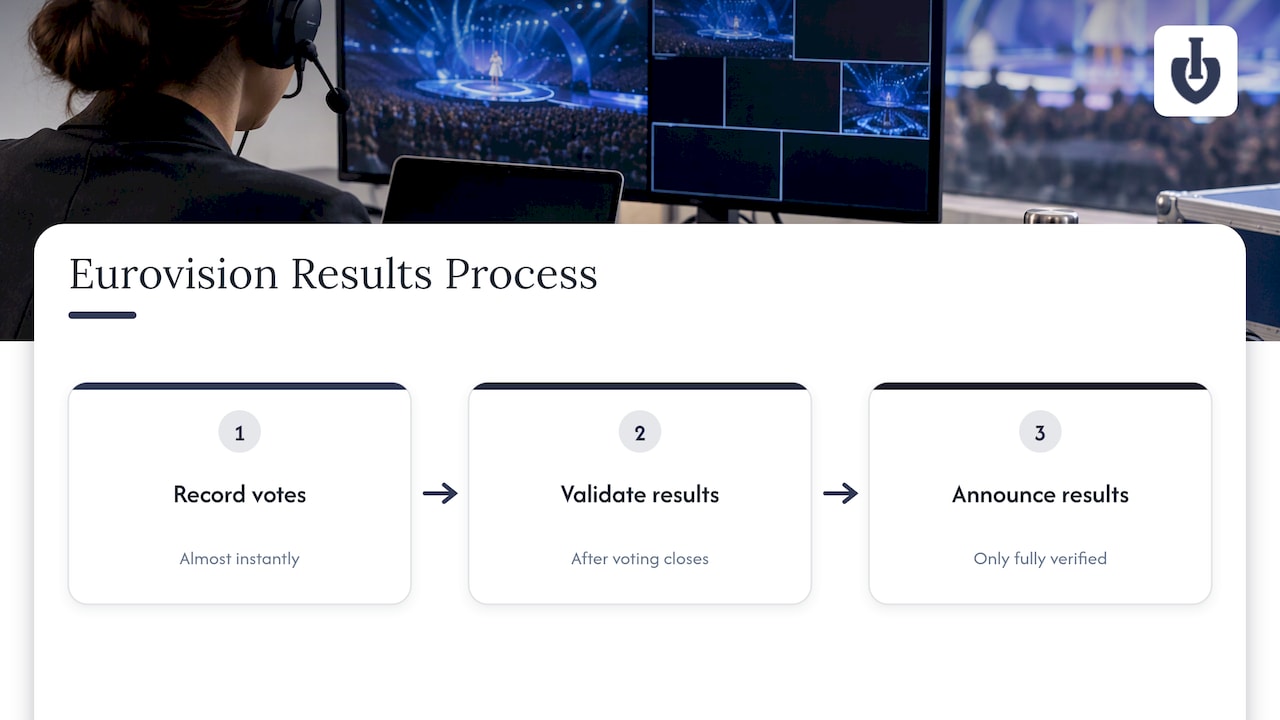
Eurovision says its votes are transmitted and recorded almost instantly as they are cast, with real-time monitoring of incoming traffic. Final validation and reconciliation happen right after voting closes, and an on-site team makes sure only fully verified results are displayed and announced during the broadcast.
The lesson for any organizer is the split between two jobs. Collecting and counting votes happens continuously. Declaring a winner happens only after validation.
America’s Got Talent: a hard cutoff and an on-the-spot count
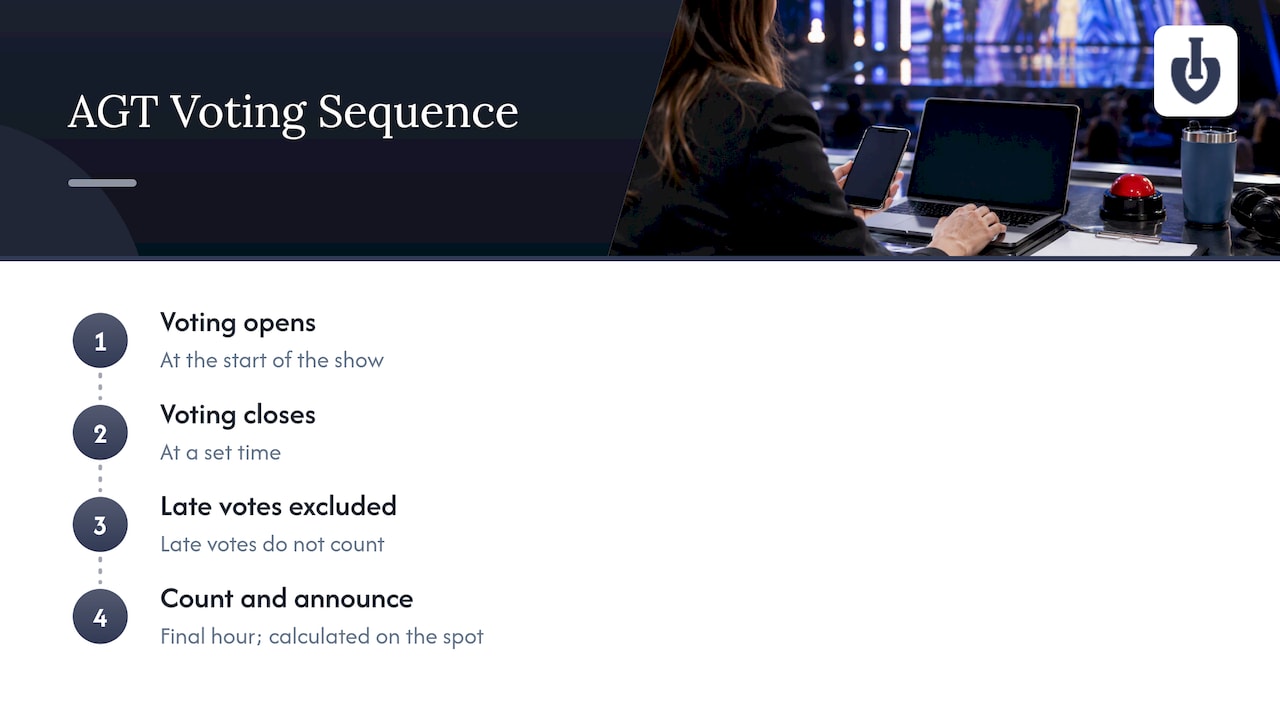
NBC’s guide to the live episode explains that voting opens at the start of the show and closes at a set time, and that the final hour is a results show where votes are calculated on the spot and announced right away. Viewers have to vote early because late votes do not count.
For your own event, this is the case for a visible countdown and automatic closing. A voting window that ends at a defined moment is easier to defend than one that someone closes by hand.
Sky Italia’s X Factor: sharing a temporary ranking
Sky Italia’s report on its voting platform describes near real-time results sharing introduced in 2022, where the host shares a temporary ranking while voting is still in progress. It also notes that closed sessions are checked live by a notary who documents the results, and that the platform reached a peak of 400,000 votes per minute.
That is the hybrid format at broadcast scale: a ranking you can talk about on stage, plus a documented check when voting ends.
Choose your results format and rules before voting opens
The most common live-results problem is not technical. It is a rule that nobody wrote down. Before you launch, settle these points and publish them where voters can see them.
The BBC’s audience interactivity guidance says organizers should consider whether a public vote is appropriate, choose a method that suits the target audience, make sure rules and terms are clear, plan with adequate resources, and agree a contingency plan before the vote runs. Referendum Lab’s guide to online voting adds that the building blocks are a defined ballot, a fixed voting window and an automatic count with an audit trail.
Turn that into a short rulebook:
| Decision | What to fix in writing |
|---|---|
| Voting window | Exact opening and closing time, with time zone |
| Who can vote | Anyone, logged-in users, or verified identities |
| Votes per person | One per category, one per day, or unlimited if paid |
| Paid votes | Whether they exist, their price, and whether they affect the ranking |
| What is shown live | Full leaderboard, top few, percentages only, or nothing |
| Tie rule | How a tie is resolved and who decides |
| Final announcement | When and how winners are confirmed |
| Contingency | What happens if the site goes down or a result is challenged |
The tie rule and the contingency line are the two most often skipped. Write both now, because you will not want to invent them under pressure.
Choose a voting method that matches your audience
Izivote supports several voting modes, so you can match the method to the event. Our voting types guide covers how each one works.
- Open voting. Anyone with the link can vote. It is fast and low friction, which suits casual community contests and school events. It also needs the most monitoring.
- Login-based voting. Voters sign in first, which ties each vote to an account. Read how login-based voting works before you choose it.
- Identity-based voting. Voters confirm who they are, for example by email. Our guide to email verification voting explains when this fits.
- Paid voting. Voters buy votes, which turns the contest into a fundraiser. See the comparison of open and paid voting for how each affects fairness.
A simple way to decide: the higher the stakes and the more money involved, the stronger the identity check should be. A office photo contest can run open. A pageant with a cash prize or a charity gala with ticketed votes should not.
Show live results without losing trust
A live display can create excitement or doubt. What decides which is mostly how you present it.
Label what the audience is seeing
If a leaderboard moves while voting is open, say it is provisional. A line such as “Current standings, final results confirmed after voting closes” sets the expectation. Sky Italia’s practice of sharing a temporary ranking while voting is still in progress works because the host frames it that way.
Pick the right display for the room
- On a big screen at a live event: show the top three or top five per category with large nominee photos, not a full table. Audiences read a screen from a distance.
- On a public results page: show every nominee with a photo, name and vote count or share, so entrants can point their followers to it.
- On social channels: post screenshots at set intervals, such as at the halfway point and one hour before close, instead of constant updates.
Live scoreboards change how participants feel about an event. A write-up on why live results change the participant experience makes the case for tournaments, and the same logic applies to fan awards. Pairing a visible leaderboard with good audience engagement strategies keeps people returning to the page while voting is open.
Decide what you hide
If the reveal is part of the show, hide the final hours. A common approach is to freeze the public display shortly before close while the count continues behind the scenes. Announce the freeze in your rules, so nobody reads it as manipulation.
Keep the count clean: duplicates, fraud and monitoring
A live leaderboard attracts attention, and attention attracts gaming. Eurovision describes its integrity approach as a combination of telecom controls, platform safeguards, real-time monitoring and post-vote verification, so only valid votes are counted. You can use the same layers at your own scale.
- Limit what one person can do. Decide how many votes each voter gets, and enforce it through accounts or verified identities, not only a browser cookie.
- Watch the live feed for spikes. A nominee who jumps by thousands of votes in minutes deserves a look. Our guide to real-time vote monitoring shows what to watch for during an event.
- Use the strongest identity method you can afford in friction. Each extra step reduces abuse and also reduces turnout, so match it to the stakes.
- Review flagged votes before the reveal. Keep a short list of anomalies and decide ahead of time what you will do with them.
- Keep a record. An export of votes by time and category lets you answer a challenge with facts.
Security researchers also warn that polls, whether authenticated or anonymous, can be manipulated if validation is weak, which is why oversight matters more than a polished interface.
Verify the tally and announce winners
The reveal is where trust is won or lost. The big awards share a pattern: a defined count, an independent check and tight control over who knows the result.
- The Academy says Oscars voting is by secret online ballot tabulated by an independent accounting firm, and winners are announced live on the broadcast.
- The Tony Awards rules say online balloting runs in the weeks before the ceremony and that strict precautions keep the winners’ names known only to a limited number of accounting firm representatives until the telecast.
- Eurovision describes an audit step after voting closes to confirm compliance with the rules before results enter the official tally.
- The BBC says votes must be run in a robust, fair and accurate manner, and that enough time must be allowed between closing and announcing so votes can be received, verified and collated, especially in live programming.
For a fan award, you do not need an accounting firm. You do need a repeatable routine:
- Voting closes automatically at the published time.
- One named person exports the final totals and checks them against the live dashboard.
- Flagged or invalid votes are handled by the rule you wrote earlier.
- A second person confirms the winners before they go into the script or the envelope.
- Winners are announced, and the results page is updated to show the confirmed standings.
Allow at least a short buffer between close and reveal. Even a few minutes lets you complete steps two to four without rushing.
A run-of-show timeline for a live award
This timeline works for a gala, a stream or a school showcase.
| When | What happens |
|---|---|
| Weeks before | Publish rules, categories and nominee profiles. Open the voting page. |
| During the campaign | Share nominee links. Check the dashboard daily for unusual activity. |
| Day of the event | Remind voters of the closing time. Test the results screen. |
| During the show | Show a provisional ranking if your rules allow it. Take final votes up to the cutoff. |
| Close | Voting ends automatically. Freeze the display if you planned a reveal. |
| Verification | Export totals, check flags, confirm winners with a second person. |
| Announcement | Reveal winners and publish the confirmed results page. |
Privacy, accessibility and payments to plan for
A few practical points belong on your checklist before you collect votes from the public.
- Privacy. If voters sign in or verify an email address, tell them what you collect and why, and link to your privacy notice from the voting page. Collect only what the voting method needs.
- Accessibility. Make sure nominee names, photos with descriptive text, buttons and the results display can be used by people with different abilities. Check your screen colors for contrast, and do not rely on color alone to show who leads.
- Payments. If you run paid voting, state the price per vote, what a vote does, and whether purchases are refundable, before the voter pays. On Izivote, paid voting carries a platform fee of 10% per vote, which is listed on our pricing page. Our article on the 10% fee, sponsors and fairness explains how organizers handle it.
If your event involves minors, regulated fundraising or a prize with legal conditions, check the rules that apply where you operate with a local attorney or your fundraising regulator before launch. Rules differ by country and state.
Run live results with Izivote
Izivote is built for public audience awards, so the pieces in this guide are part of the platform: multi-category voting pages, nominee photos and profiles, several voting modes, automatic vote closing, and a dashboard with real-time analytics for organizers. You can embed the voting page on your own site and use paid voting to raise funds for the event.
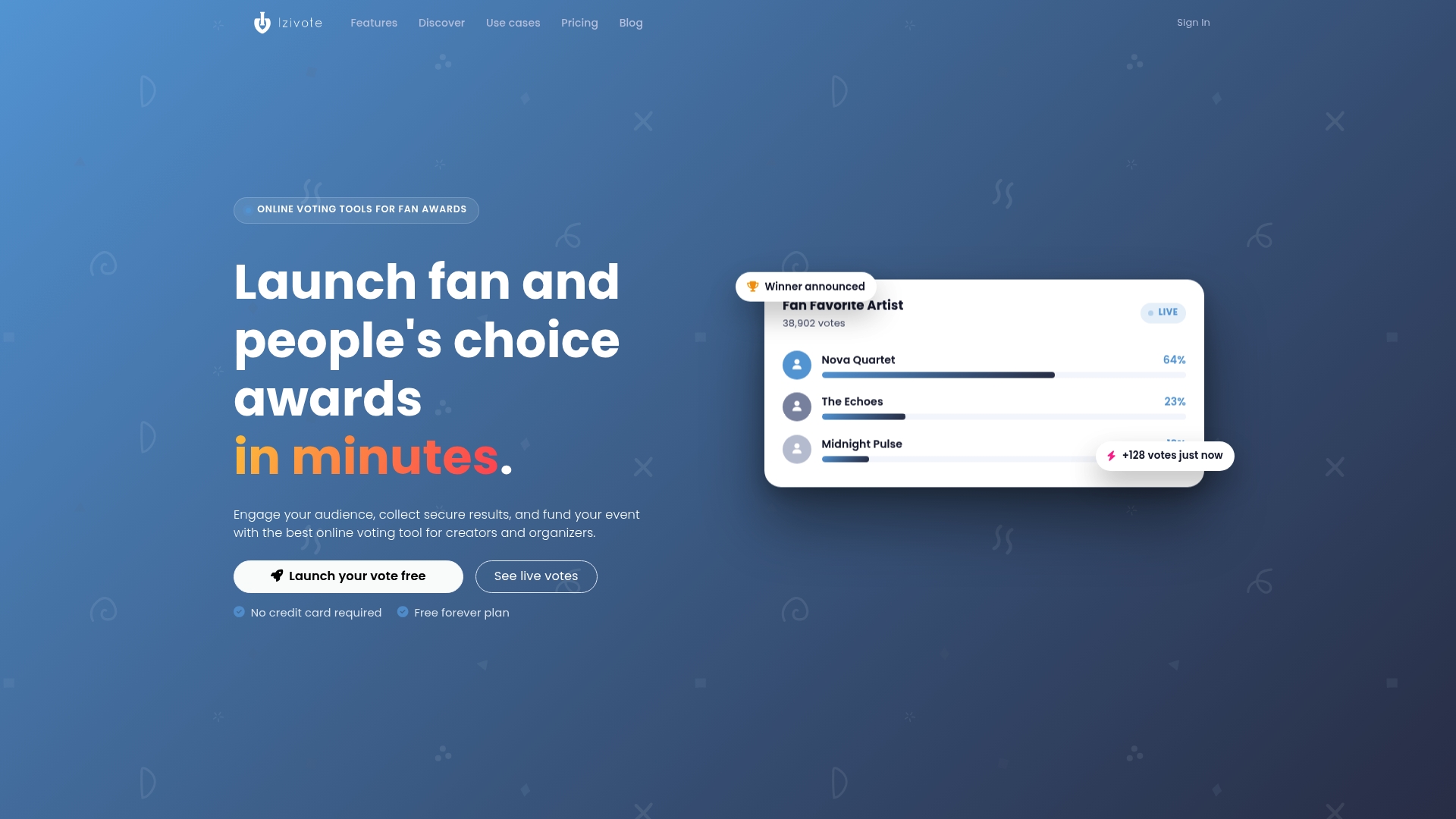
The Free plan lets you set up a small event without a published fee. The Pro plan is $6 per month or $60 per year, and Premium is $14 per month or $140 per year, as listed on the pricing page. Ready to build your first ballot? Create a fan award or online vote, or see how the platform handles people’s choice awards and live event voting.
Pre-launch checklist
Go through this list the week before voting opens.
- Rules published, including the closing time, vote limits, tie rule and what the live display shows.
- Voting method chosen and tested on a phone and a laptop.
- Nominee photos and short profiles uploaded for every category.
- Results display tested on the actual screen or stream you will use.
- Two named people assigned: one to monitor the dashboard, one to confirm the final tally.
- Contingency plan agreed: what you do if the connection drops, a result is disputed or a fraud pattern appears.
- Announcement script written with a line that separates provisional standings from confirmed results.
FAQ
How do award shows show live results?
Most shows count votes continuously and display a provisional ranking or nothing at all until the reveal. When voting closes, the totals are validated and checked before the winners are announced. Eurovision, for example, validates results right after voting closes and displays only verified ones.
Should I show a live leaderboard during voting?
Show one if you want excitement and sharing, and hide it if the surprise matters more. A hybrid works well: show standings while voting is open, label them provisional, and freeze the display shortly before close. Whatever you choose, put it in the rules.
How do I stop people from voting more than once?
Use a voting method that matches the stakes: login-based or identity-based voting for important awards, and open voting only for casual contests. Add vote limits, watch the dashboard for spikes and review flagged votes before you announce winners.
How long should I wait between closing the vote and announcing winners?
Long enough to export the totals, review flagged votes and have a second person confirm the result. The BBC’s guidance requires enough time between closing and announcing for votes to be received, verified and collated, particularly in live programming. For most fan awards, a few minutes is the minimum.
Sources
- Eurovision: how the voting system works
- NBC Insider: AGT live 3-hour episode
- Sky Italia improves performance with AWS
- BBC Editorial Guidelines: Audience Interactivity, Part C
- How Online Voting Works for Organisations
- A hackers’ guide to online voting systems
- Oscars.org: Voting
- Tony Awards: Rules and Regulations
- Audience engagement strategies for business growth
Recommended