


You can’t stop every duplicate vote, but you can make cheating costly and visible. The practical answer is to choose a voting mode that matches the stakes of your contest (open, email-based, login-based or identity-based), set a clear one-vote rule, and audit the results before you announce a winner. The stronger the identity check, the harder it is to vote twice. The stricter the check, the fewer people will finish a ballot, so the goal is the right level of friction, not the maximum.
This guide walks through each layer, what it catches, what it misses, and how to combine them for a fan award, a school election or a paid voting campaign.
Key Takeaways
- No single control is perfect. Cookies can be cleared and IP addresses are shared, so combine a voter limit with identity checks and an after-the-fact audit.
- One vote per email address is a useful speed bump, not a lock, because one person can own many addresses.
- Match friction to stakes: open voting for casual polls, email or login for public awards, identity-based voting where the result carries real weight.
- Written rules and a post-vote audit matter as much as software. Publish your one-vote rule and say you will remove invalid votes.
- Plan for real life: shared devices, lost access and bad connections need a documented fix before voting opens.
Table of Contents
- Why duplicate votes happen in the first place
- What each duplicate-vote control actually catches
- One vote per email: how far it gets you
- One vote per user: accounts and sign-in
- Identity-based voting and the privacy question
- Layer your defenses
- Paid voting: a different kind of duplicate
- Handling the messy cases
- Accessibility is part of the control
- Publish the rules before voting opens
- How Izivote helps you enforce one vote per person
- Choosing the right level of control
- FAQ
- Sources
Why duplicate votes happen in the first place
Most duplicate voting is not sophisticated. A fan refreshes the page and votes again. A nominee asks a group chat to vote from five phones. A relative uses three email addresses. Occasionally, someone writes a script. The motive is almost always the same: the contest is public, the prize or bragging rights matter, and voting is easy.
That last point is the trade-off. One contest-administration firm warns that low barriers to entry can invite vote spamming and fraud. Yet every barrier you add also costs you legitimate voters. Good design starts by deciding how much fraud risk you can live with, then picking the lightest control that holds that line.
A few questions help you decide:
- What is at stake? A office-lunch poll and a regional “best of” award with sponsors are different problems.
- Is money involved? Paid votes change the question from “one vote per person” to “how many votes may one person buy,” and the rules should say so.
- Who are your voters? Students on school accounts are easy to identify. Anonymous fans on social media are not.
- Will the result be challenged? If a loser could dispute the outcome, you want records you can defend.
What each duplicate-vote control actually catches
The vendor documentation for one content platform is blunt about the limits of browser-level methods: browser cookies can be deleted or bypassed with another browser, and IP addresses do not map one-to-one to people because networks are shared and addresses change. That is why the usual toolkit stacks several controls.
| Control | Stops | Misses | Voter friction |
|---|---|---|---|
| Cookie or browser flag | Casual refresh voting | Clearing cookies, private windows, a second browser | None |
| IP address limit | Repeat votes from one connection | Shared networks (schools, offices, venues) get blocked unfairly; mobile and VPN users get around it | None |
| One vote per email | Repeat voting with the same address | Anyone with several addresses | Low |
| Email verification | Typos and throwaway addresses that never receive the code | People with several real inboxes | Low to medium |
| Login or account required | Anonymous repeat voting | Fake accounts, unless sign-up is controlled | Medium |
| Identity-based voting | Multiple votes by one verified person | Only as strong as the identity source you use | Medium to high |
| Post-vote audit | Patterns that slip through (clusters, bursts) | Nothing in real time | None for voters |
Read the table from top to bottom as a ladder. Each step costs voters a little more effort and buys you a little more certainty.
One vote per email: how far it gets you
This is the most common request, and for good reason: it is simple to explain and simple to enforce. It is also not foolproof. One contest-administration guide notes that email limits can be abused with multiple addresses, and that fraud controls often add rate limiting and suspicious-pattern analysis on top.
Three things make an email limit much stronger:
- Verify the address. Sending a code or link to the inbox proves the voter controls it. Our guide to how email verification voting works and when to use it covers the setup in detail.
- Watch for patterns. Dozens of addresses on the same domain, sequential names or votes arriving seconds apart are signs of a batch.
- State the rule. “One vote per person, one valid email per voter” gives you grounds to remove votes later without argument.
For most public fan awards, verified email is the sensible default. It stops the lazy repeat voter, and it filters out the casual fraud that makes up the bulk of the problem.
One vote per user: accounts and sign-in
Requiring a login moves the question from “which browser” to “which account.” The platform documentation suggests that you allow only signed-in users to vote and store a flag against the account, and then make multiple accounts difficult, for instance by approving registrations manually or tying accounts to email addresses.
That last clause is the catch. A login is only as trustworthy as the sign-up behind it. If anyone can create an account in ten seconds with any address, you have rebuilt the email problem with extra steps. Logins work best when:
- accounts come from a closed group (students, members, employees, ticket holders);
- the sign-in uses an identity the voter already has and does not casually duplicate; or
- you cap new registrations during the voting window and review spikes.
Izivote offers several voting modes, including open, paid, login and identity-based voting. The Voting Types and Voter Identity help page explains what each one asks of the voter, so you can match the mode to your event instead of defaulting to the strictest one.
Identity-based voting and the privacy question
When the stakes are high, such as a student council election, a membership vote or a ranking that determines a prize, you want to tie one vote to one verified person. This is where privacy comes in, and it deserves care.
A vote record that links a named person to their choice can be a problem. The U.S. Department of Labor, writing about union elections, says ballot secrecy requires that no person can identify a member with their choice, and that avoiding a connection between identity and vote is one way to preserve it. A Canadian national standard for municipal online voting similarly requires protocols that protect vote secrecy so choices cannot be traced back to identifiable voters.
Those are formal elections with legal requirements, and a fan award is not bound by them. But the principle carries over in a useful way: separate the question “has this person voted?” from the question “what did they choose?” Your system needs to know the first to enforce one vote. It rarely needs to expose the second to anyone.
Researchers working on blockchain-style voting describe the same split, using off-chain voter authentication and cryptographic hashes to prevent duplicate voting without exposing personal information. You do not need a blockchain for a fan award, but the design lesson stands: prove eligibility in one place, record the choice in another, and limit who can see both.
In practice, for an awards organizer:
- Tell voters what you collect and why before they vote.
- Collect the minimum: an email or a login is usually enough.
- Keep the voter list away from public result pages.
- Do not publish who voted for whom unless voters knew that up front.
Izivote’s enhanced voter identity experience is one example of how a platform can make identity visible to organizers without making the voting flow harder for fans.
Layer your defenses
Strong systems rarely rely on one check. Academic work on electronic voting describes layered validation, such as backend authentication followed by cryptographic verification of vote hashes, as a dual defense that significantly reduces the success of replay attacks and ballot stuffing. You can borrow the idea at awards scale without any cryptography:
- At the door: require a verified email or a login, depending on the mode.
- At the ballot: apply a per-voter limit per category, and per day if your rules allow repeat voting.
- Behind the scenes: rate-limit bursts, flag clusters, and keep a timestamped record of each vote.
- After the close: review the data and remove invalid votes before results are final.
The fourth layer is the one most small organizers skip, and it is the one that wins arguments. A UK theater publication running a readers’ awards in 2020 combined a one-vote-per-person rule, a valid-email requirement, a ban on automated votes and post-vote auditing. It then reported removing more than 10,000 duplicate votes in one week, including duplicate email and IP-address patterns. The point is not the number. It is that the controls at the door let them through, and the audit caught them afterward.
Should you show live counts?
Live results are exciting, and they can also fuel gaming. Contest experts advise that in high-stakes contests you avoid displaying real-time raw vote counts or percentages, since they can encourage vote-buying or discourage supporters of trailing candidates.
A reasonable approach: show live results for low-stakes fan polls where momentum drives sharing, and hide or round them for contests where a prize, sponsorship or reputation is on the line. Either way, keep the full numbers in your organizer dashboard. Our overview of real-time vote monitoring for events and awards shows how organizers watch for unusual spikes while voting is still open.
Paid voting: a different kind of duplicate
In a paid-voting fundraiser, voting more than once is the product. Supporters buy votes, and the rule changes from “one vote per person” to “votes are limited by what each person chooses to buy.” That is fine, but it must be explicit.
- Say in the rules that votes can be purchased and how many votes each payment buys.
- Keep free and paid votes distinguishable in your records.
- Treat refunds, chargebacks and failed payments as reasons to adjust the tally.
- Decide whether paid and free voting run together or in separate rounds.
Izivote charges a platform fee of 10% per vote on paid voting, which the paid voting page describes, and our comparison of open and paid voting helps you choose between them. If you are weighing the fundraising side, the 10% fee, sponsors and fairness is worth reading before you publish your rules.
Handling the messy cases
The policy is easy to write. The hard part is the call you get on voting day. Decide these ahead of time.
Shared devices and shared networks
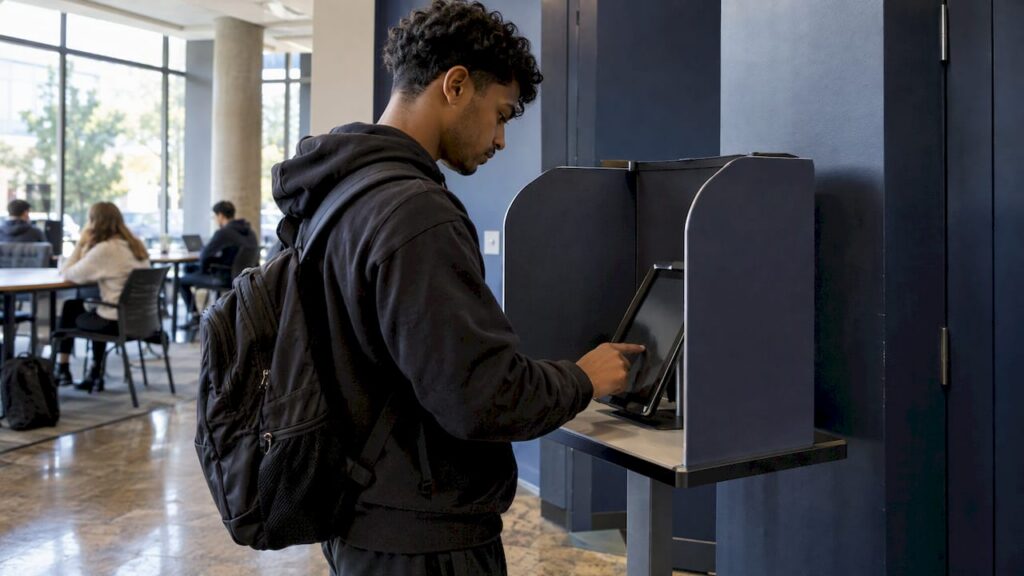
Schools, offices and live venues put many real voters behind one IP address. A strict IP limit will block honest voters, so lean on email or login controls there and keep IP data as a signal to review, not a hard wall. If voters share a tablet at a booth, require sign-in or code entry for each ballot so the previous person’s session cannot carry over.

Lost access and reissued credentials
Voters lose codes and links. When you replace them, the process matters. U.S. labor-election guidance says that when credentials are replaced or were never delivered, materials must be secured when not in use and observers must be allowed to observe the process. For a fan award, scale that down sensibly: keep a log of every reissue, confirm the person through the original email, and invalidate the old credential when you issue the new one.
Connection drops and half-finished ballots
A voter on a weak signal may tap submit three times. Make the system treat repeat submissions from the same verified voter as one vote and show a clear confirmation. The Canadian standard also recommends a timeout limit for voting sessions that balances security and usability, so voters are not logged out mid-ballot, and it says that after a voter cancels, vote information must not be stored on the voter’s device. Good advice for any ballot page.
Protecting the organizer account
Your own login is part of the attack surface. Anyone who gets into the dashboard can change settings or export voter data. Use a unique password and two-factor sign-in, and consider hardware security key compatibility if several team members manage the event.
When you suspect fraud
- Export the vote log and sort by time, email domain and IP.
- Look for bursts, sequential addresses and one domain dominating a category.
- Remove votes that break your published rule, and record why.
- Tell finalists that an audit took place, without naming individuals.
- Close voting automatically at the announced time so nobody can add votes after the deadline.
Accessibility is part of the control
A control that locks out legitimate voters is its own kind of failure. The Canadian municipal standard calls for defined accessibility requirements so that all voters can successfully cast a ballot. For awards, that means a mobile-friendly page, readable contrast, short forms and a verification step that works on a phone. Our notes on voting page layout, trust and mobile design cover the practical details.
Publish the rules before voting opens
The cheapest control is a paragraph. Put these points on the voting page and in your contest terms:
- how many votes each person may cast, per category and overall;
- what counts as a valid email or account;
- that automated or scripted votes are not allowed;
- that you audit results and may remove invalid votes;
- how paid votes work, if you offer them;
- when voting closes and how winners are decided.
Nominees who read this before voting begins are less likely to coach their followers into breaking it, and you have a clear basis for any decision you make later.
How Izivote helps you enforce one vote per person
Izivote is built for public audience awards, and it lets you pick the voting mode that fits your event: open, paid, login or identity-based. You can set up a vote quickly, embed the voting page on your own site, close voting automatically, and watch results in a real-time organizer dashboard so you can spot odd patterns while the contest is still running.
There is a Free plan for small events. Pro costs $6 per month or $60 per year, and Premium costs $14 per month or $140 per year. Paid voting carries a 10% platform fee per vote. See the pricing page for what each plan includes, or create a vote for free and test the voting modes on a small category first. If you run people’s choice awards, the same controls apply to every category.
Choosing the right level of control
| Your situation | Suggested approach |
|---|---|
| Casual poll among friends or followers | Open voting, a published one-vote rule, a quick look at the results |
| Public fan award with sponsors | Verified email, rate limiting, post-vote audit, hidden or delayed live counts |
| School or club election | Login or identity-based voting with a closed voter list |
| Paid voting fundraiser | Clear vote-purchase rules, payment records, audit of free versus paid votes |
| High-stakes ranking or prize | Identity-based voting, minimal data stored, documented audit and dispute process |
If you are running a school vote, the school election setup guide walks through the steps.
FAQ
Can you completely prevent duplicate votes online?
Not with absolute certainty. Cookies and IP limits are easy to get around, and email limits can be beaten with several addresses. You can make duplicates rare and detectable by combining verified email or login, rate limiting and an audit before announcing results.
Is one vote per email address enough?
For many casual or fan contests, a verified email is a reasonable baseline. For higher stakes it is not enough on its own, since one person can hold many inboxes. Add pattern checks, and move to login or identity-based voting when the result matters.
Should I limit votes by IP address?
Use it as a signal rather than a hard rule. Many honest voters share one IP at schools, offices and events, and others change addresses on mobile networks. Flagging a cluster for review works better than blocking it automatically.
What should I do if I find duplicate votes after voting closes?
Export the vote log, identify the votes that broke your published rule, and remove them with a note of the reason. Then recheck the final tally before you announce winners. Having the rules posted in advance makes this far easier to defend.
Does requiring identity make people vote less?
Usually some, because every extra step loses a few voters. That is why the control should match the stakes. Keep sign-in short and mobile friendly, and save the strictest checks for contests where the result truly needs them.
Sources
- Preventing duplicate poll voting and content rating (Kentico documentation)
- How to Prevent Contest Voting Fraud (Marden-Kane)
- Public Voting Contests: Rules, Risks and Best Practices (Promosis)
- National Standard of Online Voting, Municipal Elections
- U.S. Department of Labor: electronic voting systems compliance tip (2016)
- Decentralized electronic voting system using smart contracts (2025)
- When is a vote not a vote? (WhatsOnStage, 2020)
Recommended